
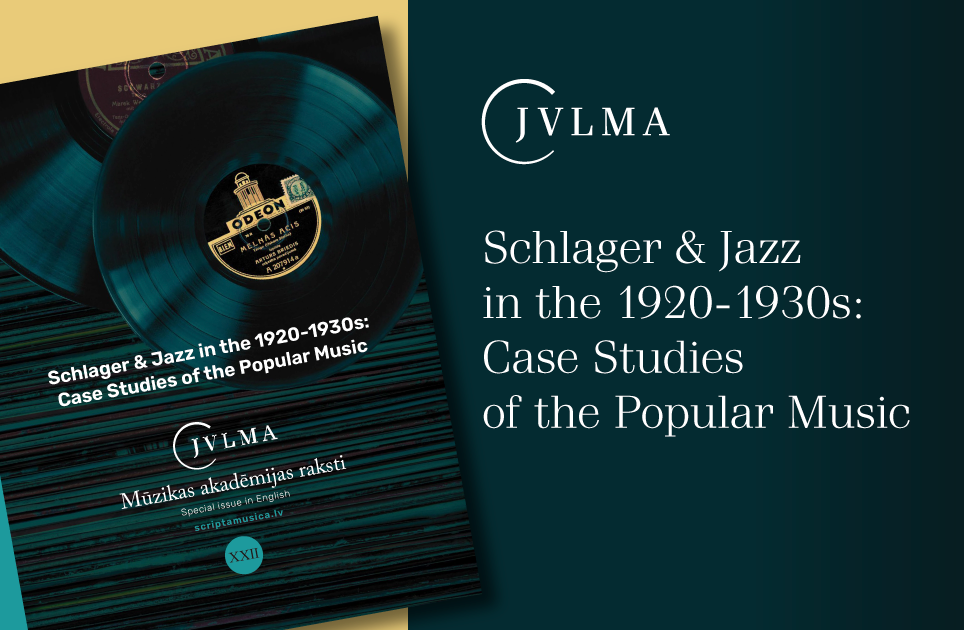
At the end of the 2024, Jāzeps Vītols Latvian Academy of Music published its annual academic journal Mūzikas akadēmijas raksti. The issue XXII “Schlager & Jazz in the 1920s – 1930s: Case Studies of the Popular Music” is for the first time published in English.
It is dedicated to the processes and case studies of the popular music in the 1920s and 1930s. Schlager (hit in English) at the time meant popular vocal and/or instrumental dance music, background music for entertainment (in theatres, restaurants, dance clubs etc.) and the related industry (sheet music and gramophone recordings as well as radio broadcast). The term was widely used in the society and stood for compositions in active circulation within the country of origins and internationally. Sometimes it was short-term fame, but in some cases the status of the hit was established for several years and kept the meaning of the testimony of its time even until the 2000s. The authors of the articles represent five countries – Latvia, Lithuania, Estonia, Germany and Serbia. The scientific editor of the issue is Jānis Kudiņš, the editor-in-chief of the journal is Lauma Mellēna-Bartkeviča. Since 2024, the journal is exclusively available online at www.scriptamusica.lv.
The first article by Jānis Kudiņš (Latvia) analyses the sources of the music stylistics and comparative contexts of the most popular tango-songs of the 1930s by Oscar Strok. The following article by Kamilė Rupeikaitė (Lithuania) uncovers the creative biography of the violinist Daniel Pomeranz (1904–1981), a bright personality in the popular music culture of Kaunas, the capital of Lithuania during the interwar period. The first thematic section unspecified in the table of contents closes with the analytic essay by Marianne Betz (Germany) about the bi-musicality in academic and popular music in the USA by Vladimir Dukelsky (1903–1969) alias Vernon Duke.
The next thematic group starts with the study by Marija Golubović (Serbia) dedicated to the distribution and flourishing of the popular music industry of the Kingdom SCS/Yugoslavia in the 1920s and 1930s and related socio-historical and political contexts. In the continuation, Alberts Rokpelnis (Latvia) analyzes the functions of the schlager sheet music printing houses and related processes in Riga during the interwar period. The article by Nikola Komatović (Serbia), in its turn, focuses on Radio Belgrade in the context of increasing popularity of schlager and folk music in Serbia in the 1920s and 1930s.
Third section is composed of the articles by Aare Tool (Estonia) providing a detailed analysis of schlager and jazz representation in the Estonian interwar press, and Indriķis Veitners (Latvia) uncovering the history of first generation of jazz musicians in Latvia and its impact to the further development of jazz in the region.
And, last but not least, the collection is enriched by the analytic essay by Dmitri Dragilew (Germany) dedicated to the life and work of Oscar Strok and Eddie Rosner (1910–1976) contextualized in the lights of the popular music scene of Berlin in the 1920s and 1930s. The comparison of the two musicians uncovers a series of interesting interactions and diverse perspectives of the popular music culture through the personal stories.
To access the articles of the issue XXII please click here: https://www.scriptamusica.lv/index.php/mar/issue/view/23