Liminal Practices in Contemporary Academia: Between Artistic Research and Research in the Arts
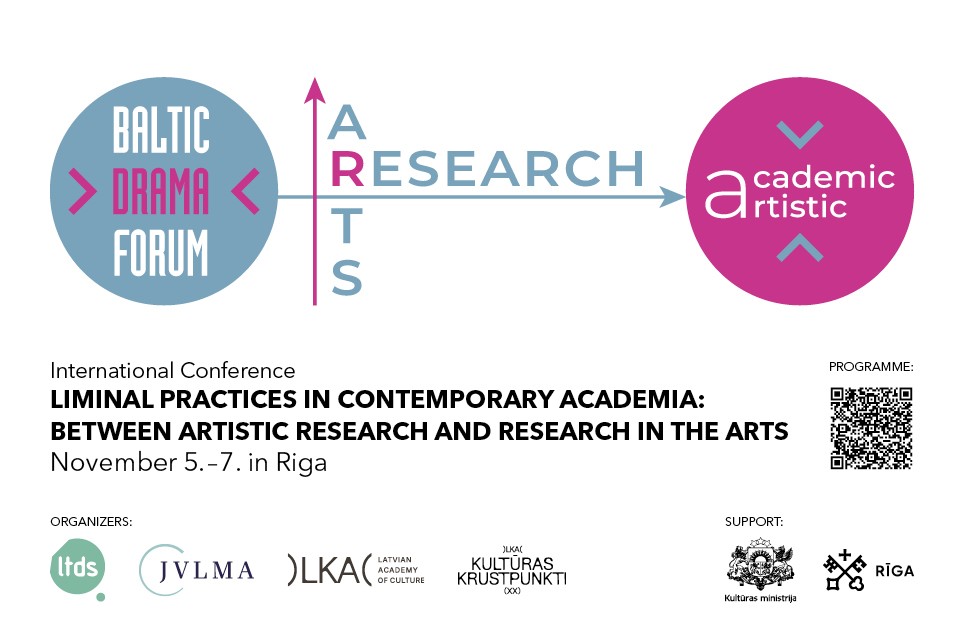
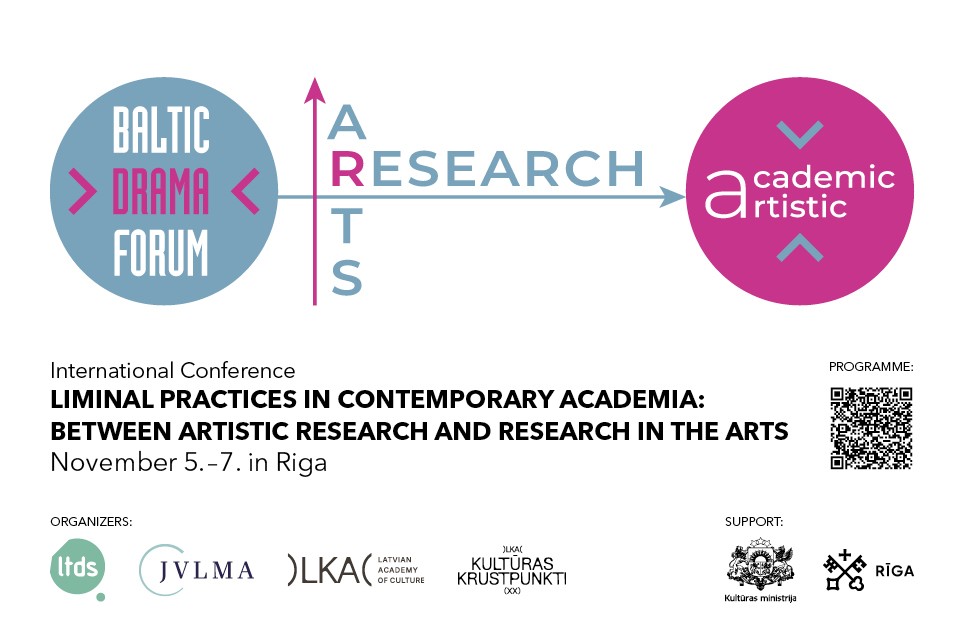
No 2026. gada 5. līdz 7. novembrim Jāzepa Vītola Latvijas Mūzikas akadēmijā un Latvijas Kultūras akadēmijā sadarbībā ar konferenci “Kultūras Krustpunkti” notiks Baltijas Drāmas foruma starptautiskā zinātniskā konference “Liminal Practices in Contemporary Academia: Between Artistic Research and Research in the Arts” (Robežprakses mūsdienu pētniecības vidē: māksliniecisko un akadēmisko pētījumu krustpunkti).
Konferencē ar paneļreferātiem uzstāsies kuratore un laikmetīgās operas pētniece Jeļena Novaka (Portugāle), JVLMA prorektore, pianiste Diāna Zandberga, režisora Romeo Kasteluči ilggadēja sadarbības partnere, kuratore un dramaturģe Piersandra di Mateo (Itālija).
Konference analizēs mainīgās attiecības starp akadēmisko pētniecību mākslā un māksliniecisko pētniecību un diskutēs par to, kā mūsdienu kultūras konteksti izaicina, paplašina un pārveido līdzšinējos priekšstatus par pētniecību un zināšanām skatuves mākslā.
Pieteikšanās konferences apmeklējumam šeit. Visi mīļi gaidīti!
BALTIC DRAMA FORUM
International Conference
Liminal Practices in Contemporary Academia: Between Artistic Research and Research in the Arts
November 5.-7. in Riga
PROGRAMME
NOVEMBER 5 in Organ Hall, Jāzeps Vītols Latvian Academy of Music
10.00 OPENING
10.15.-11.15. KEYNOTE 1 JELENA NOVAK (Universidade Nova de Lisboa, Portugal)
Becoming Elastic: Curating Knowledge in the Garden of Academia and Beyond
(Moderator: Lauma Mellēna-Bartkeviča)
11.15.-11.30 Coffee break
11.30 – 12.50 SESSION 1 LIMINALITIES: KNOWLEDGE THROUGH PRACTICE
(Moderator: Lauma Mellēna-Bartkeviča)
11.30 – 11.50 Ineta Kivle — Silent Liminality: From the ‘Not Yet’ to Performance
11.50 – 12.10 Ramunė Balevičiūtė — What Does Artistic Research Do? Practice, Knowledge, and Academic Recognition
12.10 – 12.30 Heli Reimann — Investigating Improvisation through Artistic Research
12.30 – 12.50 Kerttu Piliste — Intuition and Creativity in Academic Research and Theatre Practice: A Double Perspective
12.50 - 14.00 LUNCH BREAK
14.00 KEYNOTE 2 DIĀNA ZANDBERGA (Jāzeps Vītols Latvian Academy of Music)
Challenges of the Choreomusical Performance: The relationships between music and dance at the performance of one artist
(Moderator: Lauma Mellēna-Bartkeviča)
15.00 Coffee break
15.20 – 16.20 SESSION 2 METHODS AND PERSPECTIVES BETWEEN RESEARCH AND PERFORMANCE (Moderator Ramune Balevičiute)
15.20 – 15.40 Helen Kannus — An Encounter with the Unknown: Performers’ Perspectives on Interactive Theatre in Every Brilliant Thing
15.40 – 16.00 Vēsma Lēvalde — Staging Political Memory: Reviewing The President through Practice-as-Research and Research-Creation
16.00 – 16.20 Edgars Raginskis — The Censor Within: A Composer-Researcher’s Negotiations in the Music Theatre Work Alfas
NOVEMBER 6 in Karamazovi hall, Theatre House Zirgu Pasts
10.00 – 11.20 SESSION 3 RESEARCH AND PERFORMING ARTS: EMBODIED KNOWLEDGE (Moderator Zane Radzobe)
10.00 – 10.20 Lyu Wen — Walking, Standing, Sitting, and Lying as Research: Embodied Knowledge and the Hybrid Researcher...
10.20 – 10.40 Angelo Romagnoli — The Three Spaces of the Actor: A Metaframework for Spatial Knowledge in Performance
10.40. – 11.00 Javier Cárcel Hidalgo-Saavedra — The Golden Cage: Artistic Identity, Sedimentation and Practices of Interference
11.00 – 11.20 Yeaeun (Jena) Jang — Contemporary Art of Healing: Body-Based Self-Healing in Live Art and Audiovisual
11.20 – 11. 30 Coffee break
11.30 – 12.30 KEYNOTE 3
PIERSANDRA DI MATTEO
(PerLA | Performance Epistemologies Research Lab Università Iuav di Venezia, Italy)
Viscous Traffic: Art, Theory, and Sweaty Concepts Under Institutional Demands
(Moderator Zane Radzobe)
12.30 – 13.30 LUNCH BREAK
13.30 – 14.50 SESSION 4 BEYOND ACADEMIC CONVENTIONS: DIALOGUES, PRACTICES AND NARRATIVES OF RESEARCH (Moderator Jurgita Staniškyte)
13.30 – 13.50 Heili Einasto — What Happens to Research Knowledge When a Study Is Written as a Dialogue, a Narrative, or a Mystery?
13.50 -14.10 Monika Klimaitė-Daunienė — Artistic research: practicing the practice
14.10 – 14.30 Lauma Mellēna-Bartkeviča & Zane Radzobe — Challenges of Art criticism polyphonic mindset. Public dialogue of two critics and scholars
14.30 – 15.00 Coffee break
15.00 – 17.00 DISCUSSION “NO TIME FOR DRAMA”
NOVEMBER 7 in Karamazovi hall, Theatre House Zirgu Pasts
10.00 – 11.30 RESEARCH IN THE ARTS: LIMINAL APPROACHES (Moderator Lauma Mellēna-Bartkeviča)
10.00 – 10.20 Giuseppe Christian DiStefano: When Historical Phonology Speaks: Performing Dante through Historically Informed Florentine Pronunciation
10.20 – 10.50 Lauma Inovska — Won’t Agree to an Interview? Create a Conversation
10.50 – 11.10 Karmen Juhkam — What Do We Mean When We Talk About Composite Bodies?
11.10 – 11.30 Liping Jiang (Hannah) — Embodied Translation: Care, Reflexivity and Situated Bodies in
11.30 – 12.00 Coffee break
12.00 – 13.30 DISCUSSION Mapping Artistic Research in Latvia: Understandings and Practices
Moderators: Katrīna Dūka, Evarts Melnalksnis;
Participants:
Krista Burāne, theatre and film director, Art.D. student
Laura Feldberga, performance and visual artist, Art.D. student
Rute Marta Jansone, Art.D., multimedia artists and book designer
Agnese Krivade, interdisciplinary artist and poet
1. PANEĻREFERĀTS
JEĻENA NOVAKA
(Universidade Nova de Lisboa, Portugāle)
Kļūst elastīgam: zināšanu kūrēšana “akadēmiskajā dārzā” un ārpus tā
Bītanas Hjūzas (Bethan Hughes) grāmatā “Elastic Continuum” (K. Verlag, 2025) pētītas mainīgās attiecības starp cilvēkiem, augiem, politiku un varu, pievēršoties auga - pienenes - materiālajām un simboliskajām vērtībām. Savulaik attīstījās tendence piekopt ideju par pieneni kā gumijas aizstājēju un stratēģiski nozīmīgu resursu. Grāmatā uzdots jautājums: "Cik tālu spēj sniegties cilvēks, augs, ideja, tēls, simbols vai valsts, pirms tie neatgriezeniski pārtop par kaut ko jaunu?" Iedvesmojoties no šīs "elastīgās nepārtrauktības", Jeļena Novaka uzdod sev šo pašu jautājumu, savienojot dažādas jomas, kurās darbojas.
Vārds "akadēmija" sākotnēji apzīmēja dārzu — birzi netālu no Atēnām, kur Platons lasīja lekcijas un kas bija nosaukta mītiskā varoņa Akadēma vārdā. Novaka zināšanas izprot kā kopšanas un audzēšanas telpu, kurā elementi tiek atlasīti, kārtoti un mudināti augt savstarpējā mijiedarbībā. Kā muzikoloģe, radio raidījumu redaktore, operas pētniece, mūzikas kritiķe, dramaturģe, profesore un kuratore, kas darbojas laikmetīgās operas jomā, Novaka atzīst, ka iemācījusies būt elastīga. Spilgts piemērs robežu paplašināšanai starp dažādām darbības jomām ir izstāde “Post-Opera”, ko 2019. gadā Roterdamā viņa veidoja kopā ar kuratori, redaktori un rakstnieci Krisu Diteli (Kris Dittel). Izstāde un tās dažādie koncertu un performanču procesi parādīja ne vien mainīgās attiecības starp dziedamo balsi un ķermeni, bet arī starp māksliniecisko un zinātnisko pētniecību. Zināšanu "izplešana" jeb robežu paplašināšana ieguva konkrētu veidolu: pētniecība kļuva telpiska, dramaturģiska un eksponējama.
Jaunas zināšanas rodas pētniecības procesā. Viena no akadēmiskās vides lomām ir tās nodot tālāk. Tomēr šajā gadījumā Novaku interesē trešais, retāk uzsvērtais akadēmiskā darba aspets, kas caurvij gan pētniecību, gan zināšanu nodošanu: pašu zināšanu kūrēšana jeb organizēšana - to atlase un izkārtošana, veicinot iespēju sastapties ar radīto, to pieredzēt un apspriest. Šajā priekšlasījumā autore aplūko, ko laikmetīgā opera un viņas pašas elastīgā pozīcija starp akadēmisko vidi, medijiem un mākslas skatuvi var mums atklāt par šo kuratora darbu, kā arī to, cik tālu var izstiepties "akadēmiskais dārzs", pirms tas kļūst par kaut ko jaunu.
Jeļena Novaka darbojas Lisabonas Universidade NOVA mūzikas pētniecības centrā, Portugālē. Bakalaura (2001) un maģistra (2004) grādus muzikoloģijā ieguvusi Belgradas Mākslas universitātē, Serbijā, savukārt doktorantūrā, izstrādājot disertāciju “Singing Corporeality: Reinventing the Vocalic Body in Postopera” (2012), studējusi Amsterdamas universitātē, Nīderlandē. Pētnieces intereses aptver tematus, kā laikmetīgā mūzika, aktuālais operā, dziedāšana un jaunie mediji, kapitālistiskais reālisms, vokālās mākslas studijas, kā arī sievietes identitāte mūzikā. Novaka šajās jomās iedziļinās ne tikai kā pētniece, bet arī kā pasniedzēja, rakstu darbu autore, mūzikas kritiķe, redaktore un kuratore, kā arī veidojot saikni starp kritisko teoriju un laikmetīgo mākslu. Novaka ir arī grāmatu, piemēram, “Postopera: Reinventing the Voice–Body” (2015), kopizdevuma ar Džonu Ričardsonu (John Richardson) “Einstein on the Beach: Opera beyond Drama” (2019) autore. Šobrīd muzikoloģe raksta savu jaunāko grāmatu “Opera in the Expanded Field”, kurā koncentrējas uz dziedāšanu ārpus cilvēciskā, un šo tematu autore aplūkojusi jau iepriekš – arī esejā “Posthuman Voice Beyond Opera: Songful Practice of Holograms, Robots, Machines, and Vocaloids”, kas iekļauta krājumā “Contemporary Opera in Flux” (2024). Savu darbu Novaka prezentējusi Eiropā, Āzijā, Ziemeļamerikā un Dienvidamerikā, un autores teksti tulkoti angļu, franču, vācu, portugāļu, itāliešu, horvātu, serbu, holandiešu un zviedru valodās.
2. PANEĻREFERĀTS
DIĀNA ZANDBERGA
(Jāzepa Vītola Latvijas Mūzikas akadēmija)
Horeomuzikālas performances izaicinājumi:
Dejas un mūzikas attiecības viena mākslinieka izpildījumā
Cilvēka ķermenis spēj radīt, uztvert un paust mūziku. Profesionālu mūziķu un dejotāju ķermeņi parasti tiek trenēti attiecīgajās jomās jau kopš bērnības (Mashino, Seye: 2020). Šis pētījums ir veltīts ķermeņa kustību integrācijai laikmetīgajā mūzikā, kas īpaši radīta mūziķim (pianistam), kurš spēj dejot. Pētījuma jautājums ir: kādi ir iespējamie horeogrāfijas un mūzikas mijiedarbības veidi viena izpildītāja mākslinieciskajā praksē?Pētījuma metode ietver izpildītāja sadarbību ar līdzīgi domājošiem komponistiem un horeogrāfiem, lai radītu darbus, kuros apvienota horeogrāfija un mūzika, kā arī tai sekojošu autoetnogrāfisku refleksiju. Tas ļauj atklāt un pamatot mākslinieciskā pētījuma rezultātus un jaunus radošos atklājumus.
Horeogrāfijas un mūzikas mijiedarbības veidi variē no sinhronizācijas un strukturālas analoģijas līdz papildinājumam un pretstatījumam (Hodgins: 1992, Cook: 1998, Jordan: 2000). Tāpat Ingera Damšolta (Inger Damsholt) norāda, ka dejas un mūzikas mijiedarbības diapazona galējie punkti ir mūzikas vizualizācija un kontrapunkts (Damsholt: 1999), savukārt amerikāņu horeogrāfe Džuljeta Makmeinsa (Juliet McMains) un komponists Bens Tomass (Ben Thomas) uzsver divus mijiedarbības veidus – pastiprināšanos un pārveidošanos (McMains, Thomas 2013).
Savukārt viena multidisciplināra mākslinieka performancē ir iespējams definēt mūzikas un dejas mijiedarbības intensitāti, sākot no dialoga un beidzot ar abu mākslas veidu saplūsmi. Latviešu komponistes Indras Rišes klavierdarbā "Gaismas vilinājums" (2025) iekļauta pianista horeogrāfiskā kadence, ko veidojusi horeogrāfe Baiba Kokina un kurā ritmiskie zīmējumi tiek izpildīti, dejotājai esot puantēs. Tādējādi deja pastiprina vai ilustrē mūzikā pausto ideju – viens mākslas veids veido dialogu ar otru, taču neviens no tiem nav dominējošs.Turpretī horeogrāfijas un mūzikas mijiedarbības saplūsme rada jaunu, kvalitatīvi atšķirīgu nozīmi, kas nepastāv nevienā no šī jomām atsevišķi. Piemēram, latviešu komponistes Anitras Tumševicas un horeogrāfes Milanas Komarovas darbā "Kalnu kristāls" (2024) elektroniskās mūzikas ieraksts tiek kombinēts ar dzīvo klavierspēli un dejas priekšnesumu. Idejas pamatā ir garīgās un fiziskās pasaules – ideālā un nepilnīgā – mijiedarbība un savstarpējā saskaņa; to iedvesmojis Bībeles fragments par Dieva godību, kuras mirdzums līdzinās visdārgākajam dārgakmenim un ir dzidrs kā kristāls (Jāņa atklāsmes grāmata 21:11). Arī komponistes Lindas Leimanes un horeogrāfa Raimonda Martinova darbs "Eņģeļkauls" (2026) atklāj mūzikas un dejas saplūsmi. Komponiste saka: “Katra spārna pamatā ir kaulu struktūra. Katras kustības graciozitāti veido pretestība. “Eņģeļkauls” ir iztēles neredzamā anatomija: lidojuma spriedze, klusā rūpju arhitektūra, spēks, kas padara maigumu iespējamu. Savā būtībā skaņdarbs ir kluss veltījums tiem, kas neredzami aizsargā, un kauliem, kas mūs nes, kad aizmirstam, kā lidot.”
Diāna Zandberga ir pianiste, kuras darbība cieši saistīta ar māksliniecisko pētniecību. Šobrīd viņa strādā kā Jāzepa Vītola Latvijas Mūzikas akadēmijā kā zinātniskā un radošā darba prorektore, Doktorantūras skolas vadītāja un Klavieru katedras asociētā profesore. Pēc maģistra grādu klavierspēlē Jāzepa Vītola Latvijas Mūzikas akadēmijā viņa ir ieguvusi arī doktora grādu muzikoloģijā. Diāna ir mācījusies pie leģendārā pianista Lazara Bermana un pilnveidojusi savu meistarību pie Alisijas de Laročas. Jau vairākus gadu desmitus Zandberga aktīvi koncertē Eiropas valstīs, ASV un Brazīlijā, ir vairāku desmitu dažādu komponistu klavierdarbu pirmatskaņotāja, ieskaņojusi astoņus klaviermūzikas albumus, tostarp ar latviešu komponistu darbiem – Daces Aperānes Skaņas un atskaņas (Skani, 2015), Imanta Zemzara klaviermūziku Kāda cita Ceļiniekfantāzija (Skani, 2021), Latviešu klavierainavas (Skani, 2022), kā arī uzrakstījusi zinātnisku monogrāfiju par Jāzepa Vītola Latvijas Mūzikas akadēmijas Klavieru katedras vēsturi (Musica Baltica 2020).
3. PANEĻREFERĀTS
PIERSANDRA DI MATTEO
(PerLA | Skatuves mākslas epistemoloģiju pētniecības laboratorija Venēcijas IUAV universitāte)
Viskozā mijiedarbe: Māksla, teorija un "sviedrus prasošie jēdzieni" institucionālo prasību apstākļos
Teorija un prakse nav savstarpēji nošķirtas jomas, bet gan konkrētos apstākļos situēti un materiāli iesaistīti domāšanas veidi, no kuriem katrs ir atbildīgs par saviem rašanās un veidošanās nosacījumiem. To savstarpējās attiecības raksturo viskoza caurlaidība (viscous porosity) — materiāls savijums, kurā caurlaidība nekad nav bez pretestības. Tas, kas pārvietojas starp dažādām praksēm, sastopas ar pretestību, atstāj pēdas un pārveido pašus mijiedarbības priekšnosacījumus. Šo spriedzi raksturo filozofes Sāras Ahmedas (Sara Ahmed) jēdziens sweaty concepts — «sviedrus prasošie jēdzieni», kas apzīmē domāšanas darbu situācijās, kuras pretojas pieejamajiem apraksta un skaidrojuma veidiem, liekot pārskatīt un pārveidot līdzšinējos konceptuālos ietvarus.
Kas notiek, kad mākslinieciskajai praksei tiek izvirzīta prasība skaidri formulēt savas metodes un pamatot tās radītās zināšanas? No vienas puses, šāda prasība var veicināt prakses precizitāti, padarot tās darbības principus uztveramus un tālāk nododamus. No otras puses, tā var piespiest māksliniecisko praksi izvirzīt apgalvojumus, kurus tā nespēj pamatot, pārvēršot mākslinieku-pētnieku par subjektu, no kura tiek sagaidīta pastāvīga pielāgošanās, saprotamība un produktivitāte.
Balstoties savā ilggadējā dramaturģiskajā sadarbībā ar režisoru Romeo Kasteluči, kā arī pieredzē starptautiskā kuratoriālā un akadēmiskā vidē, Piersandra di Mateo pievēršas jautājumam par to, kā šī viskozā mijiedarbe pārveido skatuves mākslas, teorijas un pētniecības iespējas uztvert, formulēt un radīt zināšanas.
Piersandra di Mateo ir itāļu skatuves mākslas pētniece, dramaturģe un kuratore, kuras akadēmiskā un profesionālā darbība aptver laikmetīgo dramaturģiju, balss un klausīšanās politiskās dimensijas, nedzirdīgo epistemoloģijas, kā arī kuratoriālo un institucionālo prakšu izpēti. Viņas pētniecības centrā ir zināšanu radīšanas un tālāknodošanas procesi, īpašu uzmanību pievēršot to saiknei ar kolektīvās dzīves formām un skatuves mākslas praksēm. Kopš 2008. gada di Mateo ir ievērojamā itāļu teātra un operas režisora Romeo Kasteluči (Romeo Castellucci) ilggadēja teorētiskā līdzstrādniece un dramaturģe, piedaloties viņa teātra un operas iestudējumu veidošanā nozīmīgās starptautiskās kultūras institūcijās. Šobrīd Piersandra di Mateo ir kuratore projektā FAULT. Field for Artistic Unmastery and Living Transmission, kas tiek īstenots Lugāno mākslas un kultūras centrā LAC Lugano Arte e Cultura, kā arī Venēcijas IUAV universitātes pētniecības laboratorijas PerLA | Performance Epistemologies Research Lab dalībniece. Šajā universitātē viņa vairākus gadus darbojusies arī kā pasniedzēja. 2026. gadā Piersandra di Mateo ir asociētā pētniece (Associate Research Scholar) Kolumbijas Universitātes Itālijas padziļināto studiju akadēmijā Ņujorkā (Italian Academy for Advanced Studies), savukārt 2017. gadā bijusi viespētniece Ņujorkas Pilsētas universitātes doktorantūras centrā (CUNY Graduate Center). Viņa lasījusi lekcijas un vadījusi seminārus vairākās starptautiski nozīmīgās augstākās izglītības un pētniecības institūcijās, tostarp Hārvarda Universitātē, Pensilvānijas Universitātē, Honkongas Radošo mediju skolā, Šanhajas Teātra akadēmijā, Singapūras LASALLE College of the Arts, Amsterdamas DAS Theatre un SNDO, Kvebekas Universitātē Monreālā (UQAM), kā arī MITsp Sanpaulu.
BALTIC DRAMA FORUM
International Conference
Liminal Practices in Contemporary Academia: Between Artistic Research and Research in the Arts
November 5.-7. in Riga
PROGRAMME
NOVEMBER 5 in Organ Hall, Jāzeps Vītols Latvian Academy of Music
10.00 OPENING
10.15.-11.15. KEYNOTE 1
JELENA NOVAK (Universidade Nova de Lisboa, Portugal)
Becoming Elastic: Curating Knowledge in the Garden of Academia and Beyond
(Moderator: Lauma Mellēna-Bartkeviča)
11.15.-11.30 Cofee break
11.30 – 12.50 SESSION 1 LIMINALITIES: KNOWLEDGE THROUGH PRACTICE
(Moderator: Lauma Mellēna-Bartkeviča)
11.30 – 11.50 Ineta Kivle — Silent Liminality: From the ‘Not Yet’ to Performance
Liminality is approached not as a passive interval between two states, but as a dynamic threshold of becoming in which temporal, bodily, affective, and intersubjective forces converge. Drawing on Edmund Husserl’s phenomenology of internal time-consciousness and intentionality, Alfred Schutz’s account of intersubjective attunement, Bernard Dauenhauer’s phenomenology of meaningful silence, and Gilles Deleuze and Félix Guattari’s concepts of becoming, the in-between, and rhythm, the paper develops the notion of non-metric liminal rhythm.
The analysis focuses on the “no longer – not yet” structure of liminality, relating it to Husserl’s structure of retention–primal impression–protention and to Deleuze and Guattari’s rhythmic processes of territorialization and deterritorialization. In this threshold state, rhythm is understood not as measurable periodicity, but as a qualitative and affective modulation of anticipation, hesitation, repetition, and difference. Silence is considered an active temporal and relational dimension of this process: it creates a space of expectancy in which potentiality can emerge before becoming audible, visible, or articulated.
The paper further explores how liminal rhythms move towards performance. Performance is understood not as a rupture with liminality, but as its embodied actualization, in which previously silent rhythms of breath, gesture, anticipation, and temporal attunement become perceptible. Thus, liminality appears as a generative field in which individual temporal experience becomes intersubjectively shared and potentiality transforms into event.
Ineta Kivle, Dr. phil., is a leading researcher in the History of Ideas at the University of Latvia. Her interdisciplinary research encompasses phenomenology, aesthetics, the philosophy of music and art, and the history of ideas, with a particular focus on sound, rhythm, temporality, and liminality. She is the author of approximately sixty scholarly publications and two monographs, including The Philosophy of Sound (2009). Her recent publications address liminality in performance and the relationship between liminality and solidarity. In 2017, she founded the interdisciplinary research series phronesis, praxis, paideia, which she continues to lead.
11.50 – 12.10 Ramunė Balevičiūtė — What Does Artistic Research Do? Practice, Knowledge, and Academic Recognition
Artistic research has become an increasingly visible part of European higher education, yet its position within academia remains unsettled. This paper examines not primarily who the artistic researcher is, but what artistic research does: how artistic practice operates as a mode of inquiry, how it produces and communicates knowledge, and how it is made legible within academic structures.
The paper draws on observations emerging from my work in an educational context involving artistic research. These observations serve as a point of departure for considering the tensions that arise when artistic processes enter an institution shaped by established academic conventions. The discussion focuses on three interrelated questions. First, how does artistic practice relate to theory? Practice may apply, generate, transform, or resist theoretical knowledge, and its relationship to conceptual reflection cannot always be defined in advance. Second, what counts as an outcome of artistic research? Performances, processes, experiments, embodied experiences, material discoveries, and changes in artistic understanding may all function as research results, although they do not necessarily conform to conventional academic expectations of evidence and argument. Third, how is artistic research positioned within the academy? Its status varies according to national systems, institutional frameworks, doctoral structures, terminology, and assessment procedures across Europe.
Rather than treating artistic research as a stable alternative to academic research, I propose understanding it as a practice that continuously negotiates its position between artistic autonomy and academic accountability. Its significance lies not only in the hybrid identity of the artist-scholar, but in the ways artistic practices challenge existing assumptions about methodology, knowledge, authorship, and evaluation. The paper argues that the institutional recognition of artistic research depends on developing forms of academic articulation that do not neutralise the specificity of artistic practice.
Ramunė Balevičiūtė is a theatre scholar, Vice-Rector for Art and Research, and Associate Professor at the Lithuanian Academy of Music and Theatre. Her research focuses on theatre history, contemporary theatre, and artistic research. She is the author of Rimas Tuminas: Theatre More Real Than Life (2012) and co-author of Contemporary Lithuanian Theatre: Names and Performances (2019). She is a co-founder of inACT, an international peer-reviewed journal dedicated to artistic and practice-based research. Since 2023, she has co-directed the Performing Arts Research Center at the Lithuanian Academy of Music and Theatre and co-organised the international research symposium IMPACT.
12.10 – 12.30 Heli Reimann — Investigating Improvisation through Artistic Research
The role of artistic research in the humanities has grown considerably in recent years. Nevertheless, its status as a legitimate form of knowledge production remains contested within academic communities, particularly because its theoretical foundations, methodological procedures and criteria of validity are often considered insufficiently defined. This problem becomes especially apparent in the study of improvisation. Its processual, embodied and situated dimensions cannot be adequately captured through methods that separate the researcher from the object of inquiry or treat music primarily as a finished work.
This paper asks: How can improvisation be investigated as an artistic research practice in a way that generates meaningful and academically credible knowledge? It proposes a theoretical and methodological framework that brings together new materialism, phenomenology, affect theory and the performative paradigm. From this perspective, improvisation is understood not as an autonomous musical object but as a relational process in which sound, bodies, emotions, material environments and sociocultural meanings emerge through their interaction.
The paper argues that improvisation can function simultaneously as the subject and method of research. The knowledge it generates is not exclusively propositional: it is also embodied, experiential, situated and transformative. Its validity therefore cannot be assessed solely through conventional criteria such as replicability or researcher detachment. Instead, artistic research requires transparent documentation, critical reflection, dialogue between participants and a theoretically grounded account of how knowledge emerges through practice. Developing such criteria can strengthen the academic legitimacy of artistic research without reducing its distinctive forms of knowing to those of conventional scientific inquiry.
Heli Reimann is a senior researcher at the Institute of History, Archaeology and Art History, School of Humanities, Tallinn University. Her research focuses on jazz in Soviet and Cold War contexts, combining perspectives from musicology, historiography, and cultural studies. She is the author of numerous scholarly articles and the Routledge monograph Tallinn ’67 Jazz Festival: Myths and Memories. Her recent work examines jazz improvisation as a form of artistic research, with particular attention to embodied, situated, and practice-based knowledge
12.30 – 12.50 Kerttu Piliste — Intuition and Creativity in Academic Research and Theatre Practice: A Double Perspective
Drawing on my work experience as dramaturg and director’s assistant at an Estonian state theatre, as well as on my current academic research into adaptations, I will discuss the role of intuition and creativity in both pursuits, paying attention to how academic research and theatre practice complement each other. In doing so, I rely on Jane Barnette’s (2017) understanding of (adaptation) dramaturgy, as well as Margherita Laera’s (2014) treatment of adaptation, which also encompasses the practices of directors, actors, and translators.
On the one hand, my arguments are grounded in my experiences as dramaturg in productions of Shakespeare’s The Taming of the Shrew and Richard III. Here I will examine how my academic background supported my dramaturgical practice, and how my dramaturgical practice in turn helped develop faith in my intuition as a creative working tool.
On the other hand, I am reflecting on the process of formulating new academic theory based on intuitive analyses of Franz Kafka’s prose works for my PhD thesis on adaptations. Here I will examine how my experience as dramaturg emboldened me to rely on creativity and intuition as working methods in academic research.
Moreover, incorporating intuition as a research tool makes sense, considering that in many cases adaptations, the object of my research, are written intuitively, rather than following set instructions. In my pursuit to formulate a model for adapting non-reality depicting prose for the stage, the extent to which structure and academic approaches can benefit creative work remains to be seen.
Kerttu Piliste is a junior research fellow and PhD candidate in Theatre Research at the University of Tartu. Becoming fascinated with the processes which transform a source text into a theatre production through her work experience as dramaturg and director’s assistant at Vanemuine Theatre (2022–2025), Piliste’s doctoral thesis investigates the formula for dramatization in Estonian stage adaptations of Franz Kafka’s works. In 2023, she graduated the University of Tartu with an MA in Theatre Research, with a thesis titled “Theatre of the Absurd in Crisis-era Estonia (2020–2023)”. She completed her undergraduate studies in English and Art History at the University of Sussex, in 2020. Her interests include absurdist drama, modernist art and literature, and Shakespeare.
12.50 – 14.00 LUNCH BREAK
14.00 KEYNOTE 2
DIĀNA ZANDBERGA
Challenges of the Choreomusical Performance: The relationships between music and dance at the performance of one artist
(Moderator: Lauma Mellēna-Bartkeviča)
15.00 -15.20 Coffee break
15.20 – 16.20 SESSION 2 METHODS AND PERSPECTIVES BETWEEN RESEARCH AND PERFORMANCE (Moderator Ramune Balevičiute)
15.20 – 15.40 Helen Kannus — An Encounter with the Unknown: Performers’ Perspectives on Interactive Theatre in Every Brilliant Thing
Although interactive theatre has been extensively examined, much of the existing research tends to focus on the audience’s perspective, experience, and reception. While audiences must adapt to new practices that do not always position them as quiet observers of the theatrical performance, interactive theatre also contains a range of challenges for the performers. Therefore, every unpredictable encounter with the spectator during a theatrical performance often becomes an encounter with the unknown.
Considering this, many thoughts and questions arise: how do performers prepare themselves to perform in interactive theatre production? What kind of audience engagement techniques and tools do they use? How does performing in interactive theatrical performance affect the performers’ perspective on audience, their other roles, and upcoming professional work? These questions, including the strategies and embodied practices the performers have to employ, often remain unanswered.
This presentation focuses on the experience and reflection of the performers who play the role of Narrator in Every Brilliant Thing (dir. Tanel Jonas, Estonian Theatre for Young Audiences, 2022). The author has interviewed three performers who shared their experience and reflected on performing and addressing the audience in an interactive theatrical performance. The findings are presented in four main categories: the impact of performers’ educational background and previous experience (1), the techniques and tools (2), the situational contingencies of the performance (3), and the impact on other roles and professional work (4).
Helen Kannus is a PhD researcher in Theatre Research at the University of Tartu. Her doctoral research examines the changing convention of the fourth wall and its implications for performer–spectator relationships. Her academic interests include performance studies, performance analysis, and performers’ perspectives on theatrical communication. She previously worked at Tallinn City Theatre and has a professional background in journalism and communication. Alongside her research, she serves as Head of Communication and Additional Programme at the Estonian Theatre Festival DRAAMA.
15.40 – 16.00 Vēsma Lēvalde — Staging Political Memory: Reviewing The President through Practice-as-Research and Research-Creation
This paper examines Valters Sīlis’s production The President—performed at the Daile Theatre under the Latvian title Rīkojums Nr. 2 (Order No. 2)—as a case of boundary practice between theatre, political history, documentary research, and public memory. Written by Matīss Gricmanis, the production revisits the events of 2011, when President Valdis Zatlers called for the dissolution of the Latvian parliament, the Saeima, in response to the political influence of oligarchic interests. Rather than presenting these events as settled history, the performance turns them into an open artistic and civic inquiry. Using practice-as-research and research-creation as its theoretical frameworks, the paper explores how political knowledge is generated through theatrical form. The production combines documentary materials—including political statements, investigative documents and archival traces—with Brechtian estrangement, caricature, direct address and stylised performance. In doing so, it does not simply represent an earlier political crisis; it reworks the crisis as a space in which historical evidence, embodied performance and contemporary political anxieties interact. Particular attention will be given to the boundary between factual reconstruction and artistic interpretation. The stage produces neither a definitive explanation of the events nor a stable moral position. Instead, it invites spectators to recognise familiar political figures and structures while questioning the reliability of such recognition. The paper argues that this ambiguity is not a failure of historical clarity but a central research outcome of the performance. Through its formal strategies, The President investigates how democratic memory is constructed, how political responsibility is distributed, and how theatre can function as a mode of critical knowledge production. The analysis therefore positions the production as both an artistic work and a research process in which historical, embodied, and audience-based forms of knowledge remain productively unresolved.
Vēsma Lēvalde, Dr. art., is a Latvian theatre researcher, critic, and Associate Professor at the RTU Humanities and Art Centre. Her research focuses on regional cultural history, its representation in contemporary drama, the relationship between theatre and digital media, and contemporary interpretations of classical texts. A former journalist, she is also an editor and contributor to the Latvian theatre magazine kroders.lv. She is a member of the Latvian chapter of the International Association of Theatre Critics (AITC/IATC) and has developed university courses on stage culture, performative multimedia art, and contemporary theatre analysis.
16.00 – 16.20 Edgars Raginskis — The Censor Within: A Composer-Researcher’s Negotiations in the Music Theatre Work Alfas
In 2024, director Valters Sīlis, playwright Jānis Balodis, five actors and I, as composer, began creating Alfas (Dirty Deal Teatro), a music theatre work reflecting on the 2011 Jēkabpils case in which four police officers and a civilian accomplice robbed a gambling hall. Balodis libretto drew on extensive documentary research - witness testimonies, police reports, and press coverage - and its density was a direct consequence of that research. Such a text demanded musical clarity and transparency if the audience was to
follow it. Yet as a contemporary composer, I was committed to resisting oversimplification. The two pressures pulled in opposite directions: the internalised norm against triviality, characteristic of what Pierre Bourdieu calls the field of restricted production, worked against precisely what the text required. A second internal constraint arose from the subject matter itself.Representing a recent tragedy, with the family of the officer killed, the surviving perpetrators and public memory of the case all in view, demanded
ethical restraint. Drawing on New Censorship Theory, which treats internalised norms as forms of structural censorship, this autoethnographic study examines how these two inner censors shaped my compositional decisions. The analysis combines
production documents - score drafts, cuts, and rehearsal revisions - with retrospective self-reflection, including on decisions I now consider unsuccessful, such as failing to address the libretto’s length early enough.The presentation explores the conditions under which a researcher’s theoretical knowledge becomes a force that both enriches and constrains artistic practice. It also considers how documentary material resists musical time, and what this resistance reveals about translating research into art
across different media.
Edgars Raginskis is a musicologist, composer, and lecturer at the Jāzeps Vītols Latvian Academy of Music. He holds a PhD from Hong Kong Baptist University, where his research examined music censorship in Soviet Latvia through the framework of New Censorship Theory. His research interests include Soviet and post-Soviet music culture, censorship, and postcolonial perspectives. Alongside his academic work, he is active as a cultural journalist, television presenter, and theatre composer. His music theatre work Alfas, created at Dirty Deal Teatro, has been performed in Latvia and internationally.
NOVEMBER 6 in Karamazovi hall, Theatre House Zirgu Pasts
10.00 – 11.20 SESSION 3 RESEARCH AND PERFORMING ARTS: EMBODIED KNOWLEDGE (Moderator Zane Radzobe)
10.00 – 10.20 Lyu Wen — Walking, Standing, Sitting, and Lying as Research: Embodied Knowledge and the Hybrid Researcher...
When a researcher is both an artist and a scholar, how can bodily practice generate knowledge that enters academic discourse? This paper draws on my practice-based PhD research in the Humanities at Pompeu Fabra University (Barcelona). It examines how bodily awareness cultivated through Zen practice, primarily zazen and kinhin (sitting and walking meditation), extends into walking, standing, sitting, and lying, and informs my work in performance, installation, and painting. The question is how such awareness functions as an epistemic method through which action, perception, and practice participate in knowledge production.
My practice comprises three projects: the Canvas Series (exploring the relational field of body, materials, and space through water, sand, and light); Site-specific Somatic Practices (situating awareness in duration and place); and Non-Duality works (reconfiguring relations among subject, environment, and audience). Developed in dialogue with durational performance, including works by He Yunchang, Tsai Ming-liang, and Marina Abramović, these projects address body, time, and space. The case studies serve as reference points, while my practice tests and revises theoretical assumptions.
The framework draws on Nishida Kitarō's pure experience, action-intuition, and basho (place), together with Dōgen's uji (being-time), through which body, time, and space are mutually constitutive conditions of research. I distinguish an artist trajectory from a spectator trajectory: the former examines how bodily training transforms the researcher's perception and action; the latter examines how the artwork reorganizes the spectator's experience of time, space, and presence.
I argue that the practice-based humanities researcher can be a hybrid researcher: the body is both object and instrument of research. Tacit, embodied knowledge from practice enters description, discussion, and critical questioning through academic reflection. Artistic practice is an epistemic practice that produces, tests, and revises theoretical knowledge.
Lyu Wen is a practice-led PhD researcher in Humanities at Pompeu Fabra University, Barcelona. She holds degrees in image media, new media art, and digital fine art from institutions in China and the United Kingdom. Her interdisciplinary artistic practice encompasses performance, video, installation, and painting. Her doctoral project, Reshaping Perception: Zen Philosophy in Performance Art Practices, investigates how Zen philosophy informs embodied perception through the relationships between body, time, and space. Her research combines durational performance, site-specific somatic practices, and meditation-based artistic experimentation.
10.20 – 10.40 Angelo Romagnoli — The Three Spaces of the Actor: A Metaframework for Spatial Knowledge in Performance
This paper presents a metaframework for spatial experience in performance, informed by three concurrent neurophysiological perspectives: the inner space studied by research on interoception, the peripersonal space of the body's immediate reach and action, and the external space of allocentric orientation. This framing does two kinds of work: it makes practitioners' first-person accounts comparable across techniques, and it makes legible how performative traditions have theorised space in their own terms. In Zeami's Kakyō (1424), riken no ken, the actor's seeing of oneself from the spectator's position, and mokuzen shingo, eyes looking forward while the mind looks behind, describe trained competences that draw on the same neural endowment for space as the rehearsal system of the Belgian director Thierry Salmon (1957–1998). Salmon's three exercises (the Neutral Circle, the Guide, the Triangles) use spatiality as a co-creative device: knowledge is produced in witnessed solitude first, then held by pairs, and finally generated by the emergent self-organisation of four actors. Here the unit of knowing is no longer the individual performer, and autoethnography of a single self reaches its limit. The paper argues that such practices call for an epistemological model based on entangled ethnography, in which knowledge is held between practitioners in a situated context that requires innovative forms of documentation. This metaframework and its epistemological model offer a methodology for artists-researchers and a shared vocabulary for doctoral education in artistic research.
Angelo Romagnoli is an actor, scholar-practitioner, and lecturer working across performer training, neuroscience, and theatre studies. He holds a PhD in Drama by Research from the University of Kent (2024), where he developed a spatial framework for actor training informed by autoethnography and neurophysiology. Following thirty-five years of professional stage practice, his research focuses on embodied cognition, spatial perception, and performer training. He teaches Dramaturgy of Space at the University of Bari and directs The Studio Workshops. He is also Associate Editor of Culture Teatrali, co-editing a forthcoming issue on performing arts and medical humanities (2027).
10.40. – 11.00 Javier Cárcel Hidalgo-Saavedra — The Golden Cage: Artistic Identity, Sedimentation and Practices of Interference
How might an artistic identity remain plastic after years of intensive training and specialization? This paper reflects on the first year of HIC SUNT LEONES, a practice-led doctoral research project investigating how habitual artistic coordinations become sedimented and how conditions of interference and displacement might make their reorganization possible.
The inquiry emerged from my prolonged performer training and professional specialization at the Workcenter of Jerzy Grotowski and Thomas Richards, and from a growing awareness of its double potential: intensive training develops highly refined and reliable capacities, while those same capacities may become so deeply stabilized that particular ways of sensing, moving, acting, relating and deciding begin to feel natural or even inevitable. I refer to this paradox as a Golden Cage.
In my presentation I will examine a twenty-eight-day autoethnographic automatic-movement practice, specifically designed for this research, through which I began investigating this problem in and through the body. Rather than seeking new movement material, creativity or spontaneity, the practice combined forty minutes of continuous movement with video documentation, post-practice automatic writing and reflection, creating conditions for the body to do what it could and wanted to do. Alongside the solo investigation,
the practice’s ongoing development. Across these processes, techniques, gestures, bodily organizations, adaptations and fragments of previous artistic experiences became increasingly recognizable
and, at times, predictable.
While repetition made these sedimentations more perceptible, awareness did not in itself transform them. This became a methodological turning point, shifting the research from the excavation of embodied artistic identity towards constructing conditions intended to interfere with habitual coordination.
In my presentation I will consider structured interference as an emerging artistic-research strategy for investigating plasticity: not to erase embodied knowledge, but to explore how coordinations sedimented through training and professional practice might remain available without becoming inevitable ways of sensing, acting, relating and creating.
Javier Cárcel Hidalgo-Saavedra is a performance maker, artistic researcher, and PhD researcher at the Estonian Academy of Music and Theatre. His research explores artistic identity, performer training, and contemporary performance practices. He holds degrees in physical theatre and contemporary physical performance making and has over fifteen years of international experience as a performer, director, and facilitator. From 2016 to 2022, he was a member of the Workcenter of Jerzy Grotowski and Thomas Richards in Italy. His doctoral artistic research project, HIC SUNT LEONES, investigates how performer training shapes and transforms artistic identity.
11.00 – 11.20 Yeaeun (Jena) Jang — Contemporary Art of Healing: Body-Based Self-Healing in Live Art and Audiovisual
This presentation describes a practice-oriented study that develops a healing method by fusing the archetypal energy of ancient shamanic rites with modern live art and audiovisual media. It combines the two distinct aspects of traditional Korean shamanism—namely the spiritual calling and the physical trance characteristic of Northern spirit-descended shamans (gangsinmu) and the repetitive sound systems of Southern hereditary shamans (seseupmu)—using the artist's own body to mediate these elements rather than simply imitating them ethnographically. Since they had to cope with the physical limitation of right-hand paralysis, the artist changed from working with 2D animation to 3D live performance, in which the body acts as a ritual vessel; as part of the research, the artist also traced a shamanic lineage back to a great-great-grandmother, as a result of which they came to see themselves as a "Contemporary Art Ritualist."
In theory, the work draws on contemporary practices that use Kim Keum-hwa's ritual structures and trance breathing, Joseph Beuys's concept of 'social sculpture', Ana Mendieta's integration with the earth, Nam June Paik's use of electronic media, and Marina Abramović's physical endurance. The practical research uses a subtractive method—slowly removing masks and symbolic tools—to arrive at an energy circulation powered by the raw body, self-made electronic instruments, vocals, and the vibrant energy (sinmyeong) of Samulnori (traditional Korean percussion). With special attention given to TABOO (2024), the concluding piece of the CURE series performed at Bärenzwinger in Berlin, a site used to confine bears for 76 years, the presentation shows how the process of making social taboos visible can lead to their transformation into a form of healing within a space characterised by oppression. Beyond reproducing traditional clothing and symbols, the artist actualises a method for collective healing (CURE) by bringing the ritual's essence to life through the body, sound, and contemporary media.
Yeaeun (Jena) Jang is an audiovisual artist and PhD candidate in Time-Based Media. Their artistic research explores the intersections of traditional ritual, embodied performance, and contemporary audiovisual art, with a particular interest in healing and collective catharsis. Drawing on Korean traditional dance, shamanic practices, and experimental electronic sound, they approach the body as both a ritual vessel and a living puppet. Their site-specific performances and sound experiments have been presented internationally, including at the Prague Biennale (2021), Pragovka Gallery (2022), and Bärenzwinger in Berlin (2024).
11.20 – 11. 30 Coffee break
11.30 – 12.30 KEYNOTE 3
PIERSANDRA DI MATTEO
Viscous Traffic: Art, Theory, and Sweaty Concepts Under Institutional Demands
(Moderator Zane Radzobe)
12.30 – 13.30 LUNCH BREAK
13.30 – 14.30 SESSION 4 BEYOND ACADEMIC CONVENTIONS: DIALOGUES, PRACTICES AND NARRATIVES OF RESEARCH (Moderator Jurgita Staniškyte)
13.30 – 13.50 Heili Einasto — What Happens to Research Knowledge When a Study Is Written as a Dialogue, a Narrative, or a Mystery?
Academic research is commonly presented as if knowledge emerged through a linear, orderly, and impersonal process. In practice, research often resembles detective work: the researcher follows traces, compares testimonies, identifies contradictions, constructs hypotheses, pursues false leads, and repeatedly revises what seemed to be known. If research unfolds as an investigation, why should its written form conceal that process?
This paper questions the assumption that scholarly rigour requires a conventional academic format. It argues that form is not a neutral container for knowledge: it determines which voices remain audible, how uncertainty is represented, and whether the researcher’s intellectual work becomes visible. The discussion draws on chapters of my doctoral dissertation on Estonian ballet history.
Unable to begin within the expected academic register, I initially composed them as conversations. My role as researcher was divided among three figures: the Archivist, who presented documentary evidence; the Journalist, who asked questions and introduced contemporary public discourse; and the Theorist, who interpreted, compared, and doubted. Historical figures entered the conversation through documented quotations, while references and source criticism remained integral to the text. I later rewrote these chapters several times into conventional academic prose in order to “play it safe.”
The final version became more coherent, compact, and institutionally recognisable. Yet something was lost: the confrontation between sources, the distinction between evidence and interpretation, the researcher’s uncertainty and self-correction, and the reader’s opportunity to weigh competing testimonies.
The paper proposes that academic writing may itself function as artistic research when form becomes not merely a means of presenting findings but a method of inquiry and knowledge production. Artistic research can therefore contribute to scholarship by expanding the forms through which scholarly knowledge may be created, examined, and communicated.
Heili Einasto is an Estonian dance researcher and critic holding a PhD in Cultural Studies (2016). Her research focuses on Estonian dance and ballet history, with particular attention to the development of modern dance and its cultural contexts. She has published dance criticism and scholarly writing since 1991. Her publications include 100 Years of Modern Dance (2000) and Rahel Olbrei – Founder of Estonian Dance Theatre (2018), and she is co-author of Mai Murdmaa – Journey in Dance (2018). Her academic background includes studies at Central European University and several international universities.
13.50 -14.10 Monika Klimaitė-Daunienė — Artistic research: practicing the practice
What does it mean to approach artistic research through experimentation rather than established patterns of artistic production? What becomes possible when the experiment itself becomes the primary method through which artistic knowledge is generated?
My artistic research explores the decentralization of power structures within performance-making processes and the changing position of the director. Initially, I planned to create several theatre performances as the artistic outcomes of the research. However, I soon encountered a tension between theatre production and artistic research: while production requires commitment to a defined outcome, research requires space for exploration, uncertainty, and failure. Attempting to accommodate both within the same process risked subordinating research to the demands of production.
Artist and researcher Ben Spatz draws a distinction between research and performance-oriented practice, arguing that research questions are shaped by their goals. As he puts it, “I only want to underline how different these questions are once the goal of performance is removed” (Spatz 2018: 218). Drawing on this proposition, I made a conscious decision to conduct my research through experimental practice without defining an artistic outcome or form. Rather than treating experimentation as a means towards performance, I began to design and conduct experiments as research in their own right: establishing specific environments, formulating instructions, selecting tools, and observing what emerges from their interaction.
Working through this micro-level approach—focusing on one element or question at a time—the experiments repeatedly revealed unexpected and previously unconsidered aspects of the research. They opened new directions of inquiry and challenged habitual modes of artistic practice.
Based on my case studies and pedagogical practice, this paper presentation examines what becomes possible when artistic practice is released from the obligation to become a performance, and experimentation functions not as a preparatory stage of production, but as a primary mode of inquiry.
Monika Klimaitė-Daunienė is a Lithuanian theatre director and doctoral researcher in artistic research at the Lithuanian Academy of Music and Theatre. Her research examines directorial strategies that challenge hierarchical structures and redistribute power within performance-making processes. She holds degrees in theatre directing and performance practices from institutions in Lithuania and the United Kingdom. Alongside her artistic and academic work, she coordinates MA programmes in Acting and Directing with a focus on artistic research. She also co-leads a laboratory-based course investigating artistic research methodologies through collaborative creative practice.
14.10 – 14.30 Lauma Mellēna-Bartkeviča & Zane Radzobe — Challenges of Art criticism polyphonic mindset. Public dialogue of two critics and scholars
Art criticism occupies a liminal space between artistic creation and scholarly knowledge production. Rather than merely responding to an artwork, criticism creates its own form of discourse, interpretation and, potentially, aesthetic experience. This raises the question of whether criticism should be understood as a secondary practice dependent on art, or as a creative practice in its own right. The double paper explores this liminality through the polyphony of two critical voices: a theatre critic and a music, opera and theatre critic, both of whom also work as academic researchers. Their practices occupy several overlapping positions — critic, researcher, spectator, interpreter and writer — and these positions do not always speak with the same voice. Who speaks when the critic writes: the spectator, the interpreter, the researcher, or the artistically engaged writer What happens when the critical voice enters academia? Does it become more analytical, methodologically conscious and theoretically informed, or does academic discourse suppress some of the immediacy, subjectivity and stylistic freedom of criticism? And what happens when the researcher writes as a critic? Can scholarly concepts, historical knowledge and theoretical reflection become part of a critical text without turning it into academic writing? We propose “polyphonic mindset” as a way of describing this unstable coexistence of voices: the critic’s subjective and situated voice, the researcher’s analytical and evidentiary voice that may intertwine unwillingly or on purpose.
Rather than seeking a definitive answer to the question “Is art criticism itself art?”, the dialogue tackles the question as a productive provocation. Through a polyphonic dialogue between two critics and researchers, it examines criticism as a liminal practice situated between artwork and discourse, experience and analysis, subjective response and scholarly knowledge, creative writing and academic argument. The form of the presentation will mirror its argument: rather than two separate papers, the speakers will construct a polyphonic conversation in which their different disciplinary positions and voices intersect, overlap and occasionally contradict one another.
Lauma Mellēna-Bartkeviča holds a PhD degree in Arts by the University of Latvia (2018), she is an academic researcher at Jāzeps Vītols Latvian Academy of Music and actively working music and theatre critic as well as international relations coordinator at Latvian Theatre Workers Union and Head of the Latvian Section of the International Theatre Critics Association AICT/IATC. Main research interests cover such fields as opera, music theatre and music culture both from the historical and contemporary perspectives. Since 2020, Lauma Mellēna-Bartkeviča is the editor-in-chief of the only Latvian musicology journal Mūzikas akadēmijas raksti (scriptamusica.lv) Publishes reviews and articles in Latvian periodicals and professional performing arts media since 2004. In 2020, edited “Contemporary Latvian Theatre 2010-2020. A Decade Bookazine” in English. In 2025, coordinated the project of Latvian new drama translations for Gothenburg Book fair.
Zane Radzobe is a Latvian theatre researcher and critic, a researcher at the Institute of Culture and Arts Studies at the Latvian Academy of Culture, and holds teaching positions as an Assistant Professor in the Department of Communication Studies at the University of Latvia, as well as the Latvian Academy of Culture. As a Fulbright Scholar, she pursued further studies at the Graduate Center of the City University of New York. She has also participated in numerous international workshops and collaborative projects dedicated to the development of European theatre criticism. Active as a theatre critic since 2004, she regularly serves on the jury of the Latvian National Theatre Award and works as a radio presenter. Her research focuses on contemporary Latvian and European theatre and cultural communication.
14.30 – 15.00 Coffee break
15.00 – 17.00 DISCUSSION “NO TIME FOR DRAMA”
Moderator: Rasa Bugavičute-Pēce
Participants: Jelena Novak (Portugal), Piersandra di Matteo (Italy), Monika Klimaitė-Daunienė (Lithuania), Justīne Kļava (Latvia), Hinriikka Lindqvist (Finland), Mehis Pihla (Estonia)
NOVEMBER 7 in Karamazovi hall, Theatre House Zirgu Pasts
10.00 – 11.30 RESEARCH IN ARTS: LIMINAL APPROACHES (Moderator Lauma Mellēna-Bartkeviča)
10.00 – 10.20 Giuseppe Christian DiStefano: When Historical Phonology Speaks: Performing Dante through Historically Informed Florentine Pronunciation
Historical philology often approaches Dante through editions, critical apparatuses, and written evidence. This lecture-recital asks what happens when that evidence is transferred into a living body and tested through sustained vocal performance.
The project, Voce Dantis, works with Dante’s Commedia and with phonological evidence preserved in historical grammars and linguistic descriptions. It focuses on syntactic consonant gemination and on the weakening of certain consonants between vowels. Once embodied in performance, these features influence articulation, breathing, vocal continuity, rhythm, and the performer’s movement through the verse.
The voice is a trained modern voice, not a reconstructed medieval voice. The aim is therefore not to reproduce Dante’s speech, but to place a contemporary performer within a historically informed reconstruction and observe what that framework demands of a living body.
The lecture-recital centres on Inferno XXVI. Following a brief account of the reconstruction and its limits, the canto will be performed in full using selected features of Trecento Florentine pronunciation, accompanied by an English translation. Ulysses’ orazion picciola gives the performance its trajectory: persuasion, departure, and the crossing of the known world.
The demonstration asks what changes when historical phonology leaves the page and has to survive a living breath. It proposes performance not as an illustration of philological research, but as a practice through which historical evidence can be tested, questioned, and transformed into knowledge.
Giuseppe Christian DiStefano is a PhD researcher at the Complutense University of Madrid, specialising in Dante studies and practice-based research. His doctoral research investigates the authenticity of Dante’s Epistola XIII through computational stylistic analysis. His parallel project, Voce Dantis, explores the aural reconstruction of the Divine Comedy through performance-based methodologies. He has presented his research at international academic conferences, including Dante Futures (2025) and TaPRA (2026). Alongside his research, he works as a secondary-school teacher and professional actor specialising in historical diction and phonetics.
10.20 – 10.50 Lauma Inovska — Won’t Agree to an Interview? Create a Conversation
How can a professional community be researched when open discussion may entail professional risks for its members? This presentation draws on a specific methodological experience from the author’s doctoral research on the long-term sustainability of professional practice among freelance actors in Latvia under conditions of precarity. The research focuses on a small professional field in which participants know one another and are closely interconnected through their work.
While developing the empirical part of the doctoral research, the initial plan to conduct interviews was nearly abandoned. Many of the actors approached were reluctant to speak publicly about their professional experiences, including because of concerns that such openness might affect their future employment opportunities. Rather than avoiding sensitive issues, the solution was to change the way in which they were approached. A series of eight group interviews with stimulus materials was conducted with 21 professional actors. Pre-selected excerpts from press reviews, research findings and thematic questions served as starting points for the conversations, allowing discussion to move from specific situations in professional practice towards working conditions, professional identity, recognition, motivation and professional continuity. The interviews were recorded and published, with participants retaining their names and professional identities.
The presentation will also address how the material obtained through these conversations was subsequently used in the doctoral research. In the thematic interpretative analysis, several analytical categories were not predetermined but reconstructed from recurring structures of meaning, patterns of argumentation and ways of explaining professional experience identified in the empirical material. These empirically identified categories were subsequently interpreted in dialogue with the theoretical perspectives employed in the research. The presentation thus examines a specific methodological process – from developing a viable form of conversation for a sensitive professional field to inductive data analysis and the theoretical interpretation of empirically generated insights.
Lauma Inovska is an actress, director, and professional doctoral researcher in the Joint Professional Doctoral Study Programme in Arts at the Jāzeps Vītols Latvian Academy of Music, Latvian Academy of Culture, and Art Academy of Latvia. Her doctoral research examines the long-term sustainability of freelance acting careers in Latvia under conditions of professional precarity. Her research interests include artistic labour, professional identity, recognition, and qualitative methodologies in performing arts research. Drawing on fifteen years of professional experience in theatre and film, she explores the relationship between artistic practice, working conditions, and research.
10.50 – 11.10 Karmen Juhkam — What Do We Mean When We Talk About Composite Bodies?
Traditional performance analysis often relies on an anthropocentric premise: a singular, autonomous human actor navigating a stage environment. However, contemporary performance practices from digital theatre to productions highlighting the agency of matter increasingly dismantle this boundary. Drawing upon posthumanist and new materialist frameworks, this presentation investigates how the performer’s body is reconfigured when agency is shared with non-human actors. Specifically, this paper problematizes and expands the concept of the composite body, a term conceptualised in Performance and Posthumanism: Staging Prototypes of Composite Bodies (Stalpaert, van Baarle, & Karreman, 2021). Rather than treating the body as a closed biological entity, a composite body emerges through entanglements of human materiality, technological apparatuses, digital extensions, sonic environments, and organic matter, accumulating characteristics the material bodies would not have pre-entanglement.
Using selected case studies, this presentation maps out how composite bodies are perceived, categorised, and analysed in practice. It explores a categorisation of composite body types, tracing how bodies move between different modes of hybridity, such as technological extensions, ecological assemblages, and distributed sensory networks. By examining these distinct categories, the presentation highlights the dominant terminology currently used in the field and investigates how shifting between these categories alters the focus and outcomes of performance analysis.
Karmen Juhkam is a junior research fellow in the Department of Theatre Research at the University of Tartu. Her research focuses on contemporary theatre and performance studies, with particular attention to posthumanist approaches, public space, and theatre for young audiences. Alongside her academic work, she is active as a theatre critic and has contributed to several Estonian cultural publications
11.10 – 11.30 Liping Jiang (Hannah) — Embodied Translation: Care, Reflexivity and Situated Bodies in Applied Theatre
This commented performance presents one strand of my doctoral research on Embodied Translation: how somatically informed principles can be translated into applied theatre for bodies that are historically, culturally and temporally situated.
No body enters a workshop outside history. Labour, gender, migration, care, political conditions and everyday material life shape how bodies learn to move, carry, touch, wait, approach and withdraw. Across regions in Asia and Europe, histories of occupation, displacement, border change and migration have made movement, possession, proximity and leaving mean different things in everyday life. Yet history does not determine an individual body. Bodies from the same place are also formed differently across generations, as technologies, work, mobility and domestic life change.
In this presentation, I use carrying as one practical example. Weight can be approached somatically through gravity, balance, muscular effort, joints, pressure and force. A back-basket, a backpack and a wheeled suitcase all carry weight, but they ask different things of the body. They also belong to different material and social histories. The question for me is how a facilitator moves from a somatic principle to an applied theatre prompt that can meet the lived experience of the people in the room.
This is where care and reflexivity become part of workshop design. Care means taking embodied differences seriously without reducing participants to cultural or historical categories. Reflexivity means noticing how my own training, language and expectations shape what I propose, and being prepared to revise it. Participant agency is part of that process: a prompt must remain open to adaptation, pause, refusal or redirection, and those responses must be able to change what follows.
Through spoken reflection and physical demonstration, I will use carrying to make this process of situated translation visible.
Liping Jiang (Hannah) is a performance artist, movement director, and practice-based PhD researcher at East 15 Acting School, University of Essex. Her research explores somatic approaches to participatory performance, with particular attention to embodied experiences of migration, care labour, and memory. She is a co-founder of the feminist theatre collective WhichWitch, through which she develops socially engaged and movement-based performance projects. Her artistic work has been presented at international festivals, including Camden Fringe and Edinburgh Festival Fringe (2025–2026). Her current practice-based research explores the act of carrying as an embodied artistic and cultural practice.
11.30 – 12.00 Coffee break
12.00 – 13.30 DISCUSSION Mapping Artistic Research in Latvia: Understandings and Practices
Moderators: Katrīna Dūka, Evarts Melnalksnis.
Participants:
Krista Burāne, theatre and film director, Art.D. student
Laura Feldberga, performance and visual artist, Art.D. student
Rute Marta Jansone, Art.D., multimedia artists and book designer
Agnese Krivade, interdisciplinary artist and poet